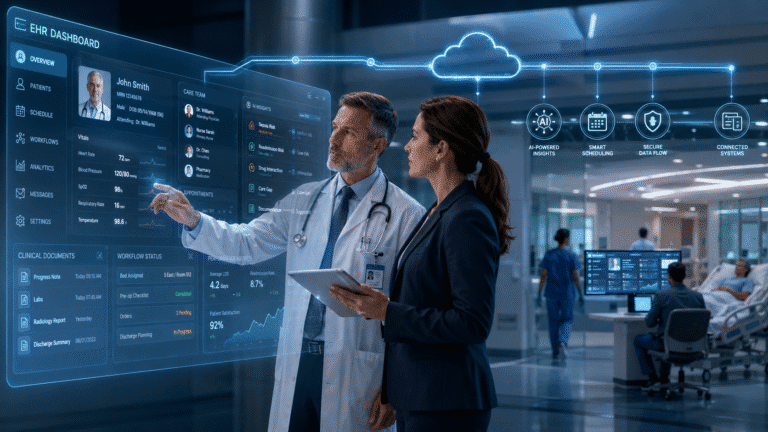

The $8.3 Billion Problem: Why Healthcare Data Silos Are Costing Patient Lives and Hospital Revenue
Disconnected health systems are one of the most expensive and dangerous problems in modern medicine. When a patient’s data lives in separate, non-communicating platforms a hospital EHR, a specialist’s practice management system, a lab portal, a pharmacy database clinicians make decisions with incomplete information. Investing in robust healthcare interoperability solutions isn’t just a technology upgrade; it’s a patient safety imperative. Expedite Talent Solutions delivers comprehensive HealthIT solutions built around seamless data connectivity and standards-based integration.
True health data integration enables a world where every authorized clinician regardless of which system they use has access to a complete, real-time patient record. The technology to achieve this exists today. The question is whether your organization has the right partner to implement it.
Core Components of Healthcare Interoperability Solutions
FHIR API Integration
FHIR (Fast Healthcare Interoperability Resources) is the gold standard for modern health data exchange. Our FHIR API integration services enable:
- Bidirectional data exchange between disparate EHR platforms
- Patient app access to their own health records via secure APIs
- Payer-provider data sharing compliant with CMS interoperability mandates
- Real-time clinical data feeds into population health tools
HL7 Integration and Legacy System Connectivity
Many healthcare organizations still operate on legacy systems that use older HL7 v2 messaging. Our integration specialists build translation layers that bridge legacy HL7 and modern FHIR standards, ensuring:
- Lab results flow automatically into the ordering clinician’s EHR
- Radiology reports arrive in structured, codified formats
- ADT (Admission, Discharge, Transfer) notifications trigger care coordination workflows
Master Patient Index (MPI) and Record Matching
One of the most technically challenging aspects of healthcare systems integration is ensuring the same patient is correctly identified across all connected systems. Our MPI solutions use deterministic and probabilistic matching algorithms to create a unified patient identity preventing dangerous duplicate or mismatched records.
Third-Party and Telehealth Platform Integration
Modern healthcare extends well beyond the hospital walls. Our EHR interoperability services connect your core systems with:
- Telehealth and remote patient monitoring platforms
- Wearable device data aggregators
- Revenue cycle management and billing software
- Population health management tools
- State and regional health information exchanges (HIEs)
Learn how our HealthIT services combine interoperability with EHR optimization, predictive analytics, and cybersecurity for a fully integrated digital health strategy.
Benefits of Breaking Data Silos Through Interoperability
A True 360° Patient View
When all systems communicate seamlessly, clinicians access a comprehensive patient record at the point of care medication history, prior imaging, specialist notes, social determinants of health, and more all in one place. This eliminates redundant testing, reduces adverse drug events, and improves diagnostic accuracy.
Improved Care Coordination Across Settings
Care coordination technology relies entirely on data availability. When primary care, specialists, hospitals, and post-acute facilities share real-time data, patients experience smoother transitions between care settings and dramatically lower rates of hospital readmission.
Regulatory Compliance and Information Blocking Rules
The CMS and ONC Interoperability Rules prohibit information blocking and mandate patient data access. Our healthcare interoperability solutions are architected to keep your organization fully compliant with these evolving mandates.
Interoperability FAQs
How long does a healthcare systems integration project take?
Scope varies significantly. A single point-to-point integration (e.g., connecting a lab system to an EHR) may take 4–8 weeks. Enterprise-level interoperability across multiple facilities typically requires 6–18 months with phased delivery milestones.
Is FHIR integration required for CMS compliance?
Yes CMS mandates that covered healthcare entities implement FHIR R4-based Patient Access APIs and Provider Directory APIs. Our team ensures your implementation meets all current and upcoming regulatory requirements.
Connect Your Systems. Connect Your Care.
Data fragmentation is holding your healthcare organization back from delivering the quality of care your patients deserve. With proven healthcare interoperability solutions built on FHIR, HL7, and enterprise integration best practices, Expedite Talent Solutions eliminates the barriers between your systems. Our HealthIT solutions are purpose-built for complex healthcare environments. Reach out today to discuss your interoperability roadmap.