

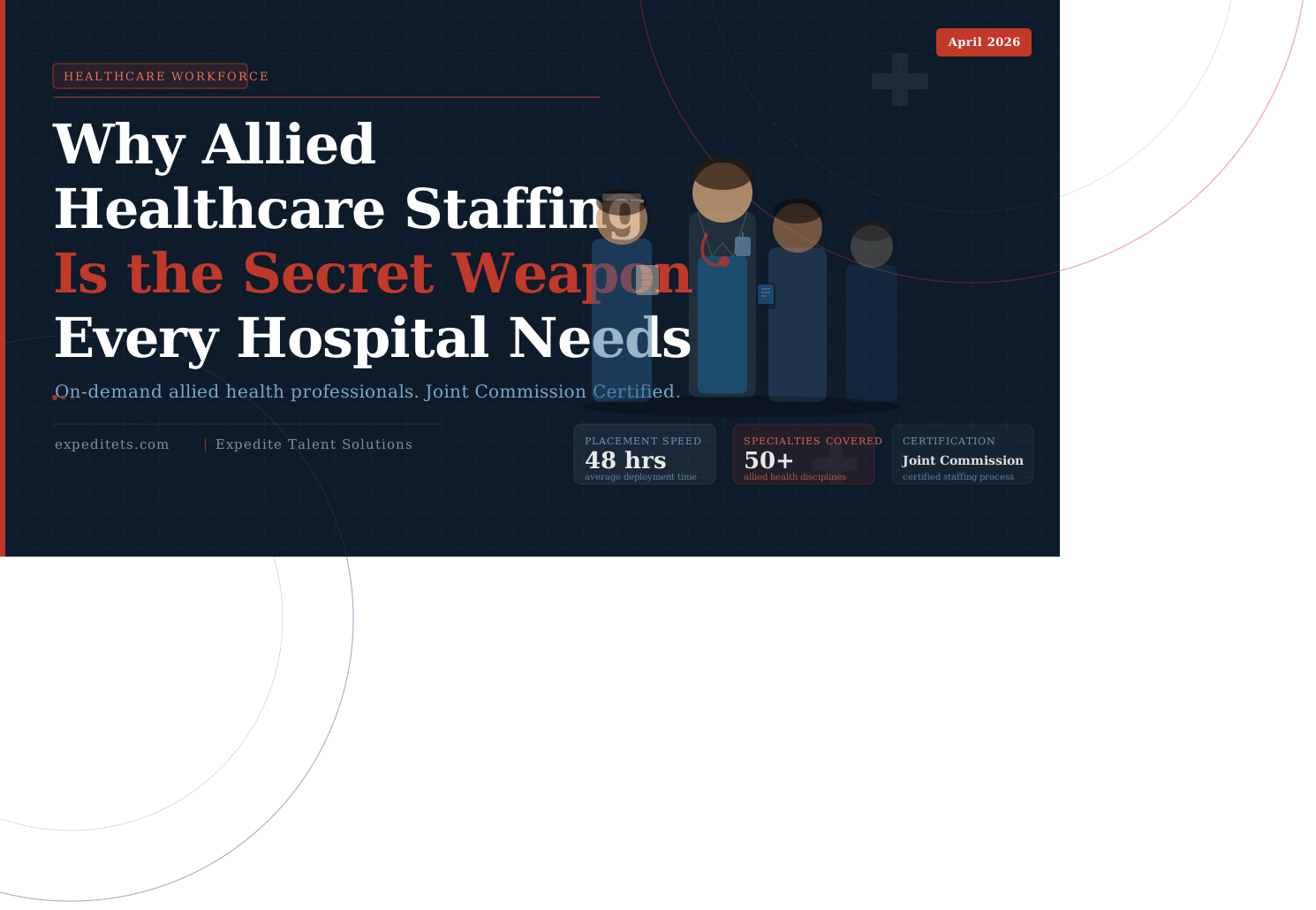
The Allied Health Staffing Gap Is Bigger Than Most Facilities Realise
Walk through any major American hospital today and you will notice something immediately. It is not just physicians and nurses keeping everything running. Physical therapists help post-surgical patients regain mobility. Radiologic technologists read scans through the night. Respiratory therapists keep ICU patients stable on ventilators. These allied health professionals hold patient care together — and yet facilities across the country are struggling to keep these roles filled consistently.
Why Demand Keeps Outpacing Supply
Three forces are pushing allied health demand higher every year:
- An ageing population that requires more frequent and more complex care across every setting
- Expanded insurance coverage bringing a larger volume of patients into the system
- Increasingly specialised treatment protocols that require specific allied health skills — not general clinical availability
The talent supply has not kept pace with any of these forces. That gap is not correcting itself. For healthcare administrators who are already balancing care quality against tight operating budgets, this is not a future problem. It is a present one — and it demands a real solution, not a temporary workaround.
What Happens When Allied Health Gaps Go Unfilled
The consequences of understaffing in allied health roles are immediate and measurable:
- Delayed diagnoses when radiology departments run short-handed
- Slower critical results when lab teams cannot maintain normal throughput
- Extended recovery timelines when therapy staffing falls below patient demand
- Burnout and turnover among existing staff asked to absorb impossible workloads
These are not abstract HR concerns. They show up in patient outcomes, satisfaction scores, and staff retention data. They affect your facility’s standing with payers, accreditation bodies, and the communities you serve. This is the daily reality that drives everything we do at Expedite Talent Solutions.
What Allied Healthcare Staffing Actually Covers
Many healthcare leaders use the term allied health without fully appreciating how broad the category actually is. Allied healthcare staffing spans dozens of disciplines, each with its own licensing requirements, competency standards, and state-specific regulations.
The Full Spectrum of Allied Health Disciplines
Some of the most commonly placed allied health professionals include:
- Radiologic and imaging technologists — X-ray, MRI, CT, ultrasound, and nuclear medicine
- Laboratory and pathology professionals — phlebotomists, medical lab technicians, and histotechs
- Rehabilitation specialists — physical therapists, occupational therapists, and speech-language pathologists
- Respiratory and cardiopulmonary professionals — respiratory therapists and echo technologists
- Surgical and perioperative staff — surgical technologists and sterile processing technicians
- Pharmacy professionals — pharmacy technicians and clinical pharmacist support roles
- Neurodiagnostic technologists — EEG technicians and polysomnography specialists
Each of these roles carries distinct credentialing requirements. Each one varies meaningfully by state. Each one requires a recruiter who genuinely understands the specialty — not someone working from a job title and a keyword match.
Why Generalist Staffing Firms Consistently Fall Short
A general staffing agency can match keywords on a resume. What they cannot do is assess whether a radiologic technologist holds a current, unrestricted licence in your specific state. They cannot evaluate whether a surgical technologist has the scrub experience your OR case mix actually requires. They do not know the clinical difference between a gen-rad technologist and a cross-sectional imaging specialist.
That depth of discipline knowledge is what separates a true healthcare staffing partner from a generalist. It protects your patients, your compliance position, and your team’s ability to function under pressure. It is the same standard we apply across all of our staffing solutions — regardless of which discipline or role type is involved.
How Expedite Talent Solutions Delivers Allied Staffing That Actually Works
Our allied healthcare staffing model is built around a single standard. We place the right professional, in the right role, at the right time. That standard sounds simple. Executing it consistently — across dozens of specialties, in facilities of every size and type — is anything but.
Rapid Access Across a Wide Speciality Network
Our allied health talent network covers the full clinical spectrum. When you need someone quickly, we move quickly. Whether that means:
- A certified surgical technologist to fill an urgent OR vacancy before the next case load
- A travel physical therapist to carry a rural facility through a high-demand season
- A per-diem echo technologist for a short-term cardiology department assignment
- A medical lab technician to maintain throughput during an unexpected staffing transition
Every placement is matched to your specific department, patient volume, and team environment. There is no generic template. Every placement decision is individual — because every facility is individual.
Covering the Gaps Before They Affect Patient Care
The most common call we receive sounds something like this. A key team member is on extended medical leave. A resignation has arrived at the worst possible moment. A seasonal census surge is outrunning internal capacity. The next shift starts in less than 48 hours.
Our pre-screened, credential-verified professionals step in fast. They reduce disruption to patient care. They relieve the pressure on existing staff who would otherwise absorb an impossible workload on top of their own. If this is your situation right now, reach out to our team and we will respond the same day.
Staffing Models Built Around Your Operational Reality
Every facility has different needs, different budget constraints, and different workforce dynamics. We offer multiple engagement models so you can choose what actually fits your situation:
- Short-term and per-diem contracts for immediate gap coverage without long-term commitment
- Extended placements for departments that need sustained workforce stability
- Contract-to-hire pathways when you want to evaluate a professional in your environment before making a permanent offer
This flexibility matters most for facilities managing unpredictable census patterns, budget cycles that shift quarterly, or speciality units where demand fluctuates significantly by season.
A Credentialing Process Built to Protect Your Patients
Every allied health professional in our network goes through a structured vetting process before we present them to any client facility. That process covers:
- Background verification — criminal history, employment records, and professional references
- Licence confirmation — active, unrestricted, and valid in the specific state of placement
- Competency assessment — speciality-specific skills evaluation relevant to your department’s needs
- Credential documentation — certifications, continuing education records, and compliance paperwork
Our credentialing process aligns with Joint Commission Certification standards. This is not a marketing claim. It means an independent, nationally recognised accreditation body has reviewed our processes and confirmed they meet the guidelines designed to protect patient safety and workforce reliability.
The Real Cost of Getting Allied Staffing Wrong
Healthcare leaders sometimes treat staffing as a cost to control. The genuine cost of poor staffing decisions almost always exceeds what appears on a single budget line.
The Visible Costs Are Just the Starting Point
A mismatched candidate who struggles through onboarding drags down departmental productivity for weeks. Repeated hiring failures in the same position consume significant recruiter time and hiring manager bandwidth. These costs are visible. They show up in reports.
The Hidden Costs Are Usually Far Greater
The costs that do not appear in a single line item include:
- Mandatory overtime for existing staff covering gaps during failed or delayed placements
- Patient care disruptions that affect satisfaction scores, outcomes data, and accreditation reviews
- Team morale damage that quietly accelerates broader turnover across the department
- Compliance exposure when credentialing is inadequate or goes unverified
A staffing partner who genuinely understands healthcare does not simply fill open positions. They protect your organisation from these downstream consequences. That is the distinction Expedite Talent Solutions brings to every allied health engagement — and it is the same standard we apply across all of our healthcare staffing services.
What Makes a Healthcare Staffing Partner Worth Trusting
Not every staffing firm is equipped to serve healthcare organisations well. The difference between a partner worth trusting and one that creates more problems than it solves comes down to a handful of concrete factors.
Recruiters Who Know the Clinical World
Our recruiters do not dabble in healthcare alongside other industries. They specialise in it. They understand licensing reciprocity between compact and non-compact states. They know the difference between an ARRT-registered radiologic technologist and an ARDMS-credentialed diagnostic medical sonographer. They can evaluate a surgical technologist’s scrub history against your OR’s specific case mix and tell you whether it is a genuine match.
That level of clinical knowledge does not come from a training manual. It comes from years of working exclusively in healthcare workforce placement — and it makes a measurable difference in the quality of every placement we make.
Independent Verification You Can Point To
Our Joint Commission Certification is the clearest independent signal of our operational quality. It is not self-awarded. It is not a membership badge that any firm can purchase. It reflects that our staffing, credentialing, and placement processes have been reviewed by an independent body against standards specifically designed for the healthcare industry.
When your compliance team, your CNO, or your accreditation reviewer asks about the quality standards of your staffing vendor, Joint Commission Certification is the answer that holds up to scrutiny.
A Communication Standard That Removes Uncertainty
We maintain active communication throughout every placement — from the moment a professional steps onto your floor to the final day of their assignment. If something is not working, we address it before it becomes a problem for your patients or your team. Our clients do not chase us for updates. We bring updates to them.
To learn more about the values and standards that shape how we work, visit our about page.
How to Build a Stronger Allied Health Workforce Starting Now
If your facility deals with recurring allied health gaps, over-reliance on last-minute agency calls, or uncertainty about how to plan for seasonal volume changes, a more strategic approach is overdue.
Understand Your Gaps Before You Try to Fill Them
The most important step before engaging any staffing partner is clarity about your own workforce picture. Which allied health roles turn over most frequently? Which specialties take the longest to fill from internal sources? Where do staffing failures have the greatest downstream impact on patient care and departmental performance? These answers shape the staffing model that will genuinely work for your organisation — rather than one that simply looks good on paper.
Demand Healthcare-Specific Credentials From Any Vendor You Consider
Joint Commission Certification, healthcare-specific recruiter training, and a credentialing process you can independently verify are not optional extras. They are the baseline for any firm you trust with allied health placements. Ask any vendor you are evaluating to walk you through their credentialing process step by step. The quality of that answer will tell you a great deal.
Build an Ongoing Partnership Not a Series of Transactions
The best allied health staffing outcomes come from sustained partnerships, not one-off agency calls when a crisis hits. A staffing partner who knows your facility your team culture, your clinical standards, your patient population responds faster and matches better every time. That is the kind of relationship we actively build with every client we serve.
Whether you need allied health professionals specifically, or a broader workforce strategy that spans clinical, non-clinical, and administrative roles, Expedite Talent Solutions has the network and the sector knowledge to help. Contact our team today and let us build a staffing plan around your actual operational needs not a generic solution designed for someone else’s facility.